
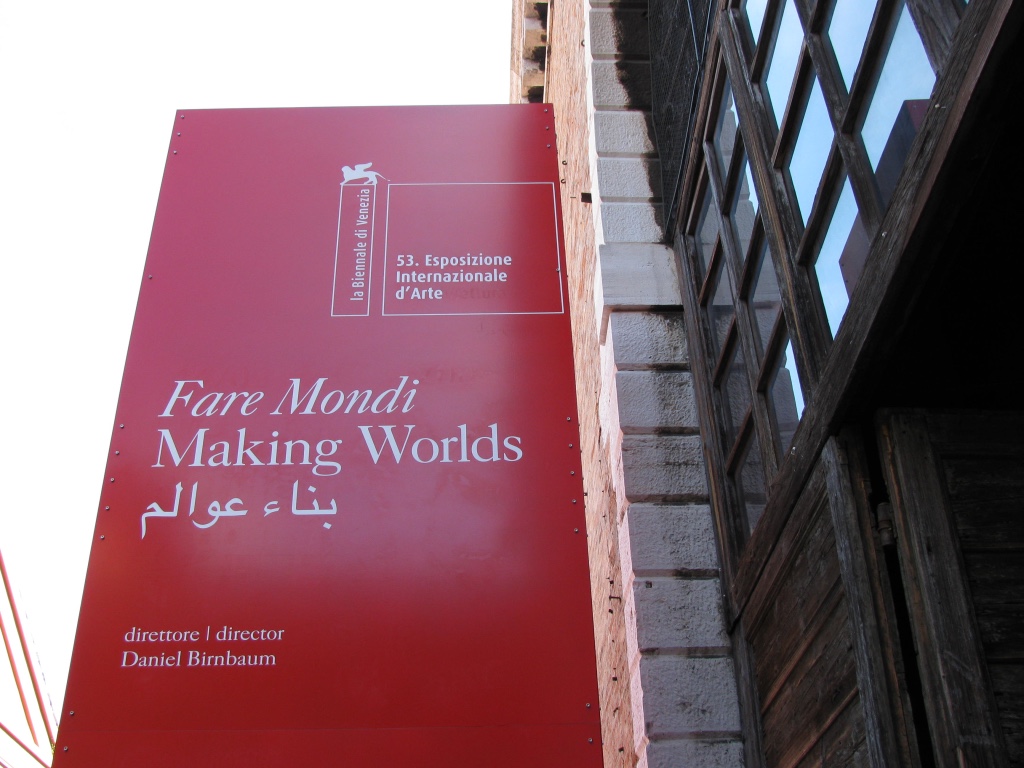
The sheer size of the Giardini and the scope of its offerings can be overwhelming when experienced within a brief time period. That being said, I have chosen the three pavilions that spoke to me both on an intuitive level and an aesthetic level, the ones that “stuck with me.” These are Bruce Nauman’s US pavilion, Adel El Siwi’s Egyptian pavilion and Elmgreen & Dragset’s Nordic-Danish collaboration.
Given the title, Topological Gardens, an allusion to Bruce Nauman’s almost religious interest in mathematics, the Philadelphia Museum seems to suggest that though Nauman’s work spans forty years, the effectiveness of its message remains relevant even today.
I must admit I would have begged to differ with this suggestion upon first entering the US pavilion where Nauman’s work is presented. With his limited color palate Nauman makes certain that his already minimalist sculpture looks somewhat sterile against the white wash walls of the gallery. The work has a detached almost inhuman feel, if not for the forms used, that would seem more at home in some lab running horrific human and animal experiments. It is quite grotesque, off-putting and confrontational in its presentation.
But one has to assume upon viewing his work that this is Bruce Nauman’s intent, to make the audience uncomfortably rethink their surroundings and their place within. Take for example Four Pairs of Heads, made of disembodied wax heads in three colors fused together in different angular variations held aloft by copper wire. Also, Hanging Carousel, a sculptural/video installation of four cast foam animals hanging from copper wire and circling a television playing a video of a fox being skinned. The most beautiful piece in my opinion was Fifteen Pairs of Hands, a veritable forest of bronze cast hands intricately and grotesquely intertwined in communication through an unreadable sign language.
The relevance of Nauman’s work had not become apparent until I had returned home and the gravity of what I had experienced in Venice settled within my psyche. As images presented themselves and connections were formed I realized that, given the content of his work and in representing the US, Nauman’s work may speak of the US’ recent liberal use of torture, or even one step further, that we treat our citizens with the same disdain and indifference as we do criminals and animals.
This interpretation asks an important question. Being that the Biennale is an international exhibition used for over a century by many countries as a political stage, is this the image of itself the US would want to portray? In the Arsenale one need not worry too much about national representation or image. However, in the Giardini with the name of each country engraved in stone across its respective edifice does this “cultural branding” grace the face of a grand monument or coldly mark a self-made grave? Given the sensitivity of the matter, whether one reads the same meaning as I have or not, it presents a troubling issue. Is this laissez-faire attitude toward art part and parcel of US cultural policy, or as research would suggest, does the US even have a cultural policy?
Assuming that this is simply reflective of US cultural policy, the Nauman pavilion may represent a breakthrough in the fulfillment of the 1st Amendment. Perhaps even a change in US foreign and cultural policy?
Though upon thoroughly researching US cultural policy I have found no clearly defined statement per se, and as many scholarly critics have suggested, the US has no cultural policy stated or unstated. However, I would beg to differ in that the US does in fact have a cultural policy. It is an unspoken policy of indifference, where art and artists, other than with less than modest grants, are untouched by the government and left to fend for themselves in a free market economy, that is, left to fend, for example, until art points an accusatory finger at governmental administration and the FBI comes knocking as they did on the door of Houston’s Art Car Museum on November 7th of 2001 (Rothschild 2002). This suggests that even if we had a clearly defined cultural policy it’s implementation would not necessarily follow it’s intent. American indifference to a cultural policy has led to the “rule of the arts” by commercial popular “artists” not necessarily concerned with the same societal issues as non-commercial artists. This further leads to the commoditization of American culture and to the “dumbing down” of its citizens.
Though the US has no clear cultural policy that explains the Nauman pavilion, the curatorial institution, The Philadelphia Museum, does. Their mission, found on the organization’s website, charging them to “in partnership with the city of Philadelphia, the region, and art museums around the globe…preserve, enhance, interpret and extend the reach of its great collections in particular, and the visual arts in general, to an increasingly diverse audience as a source of delight, illumination and lifelong learning, ” perfectly explains the curation of the US pavilion as a retrospective of this particular work. Nauman’s work most definitely illuminates for the viewer a deep undercurrent of meaning that provides for the viewer a unique learning environment. Also, lest we forget, we are at the world famous Venice Biennale which attracts 2,500 international consumers of art daily. One could assuredly say that the Philadelphia Museum with great success implements and lives up to its cultural policy.
This brings into question a second issue that the current Biennale and in particular the US pavilion raise. The original Biennale was a biennial, national, artistic exhibition where, “Each artist could participate with no more than two works, previously unexhibited in Italy.” Obviously the number of works accepted per artist had to change when the national pavilions were introduced, but the Biennale seems to have lost its purpose to exhibit new “unexhibited” work. The current art director Daniel Birnbaum confirmed this while speaking to the Buffalo group when he stated that a very large percentage of the artists represented at the current Biennale are deceased. Does this not undermine the cultural policy of the Biennale? For if museums are employed to preserve and present the art of yesterday and today then should not the Biennale be in the business of exhibiting the various new and ingenious areas art is expanding into? If not, then why even hold a Biennale?
One might justify the choices made for the US pavilion in that it was curated by a museum, so therefore a retrospective of a famous artist seems fitting given the content of most museum collections. However, though I can now appreciate the work of Bruce Nauman, I disagree with his inclusion in the Biennale to such a scale. I do, however, agree with Laura Cumming of the UK Observer when she speaks of Nauman, “…it is worth seeing his pavilion first just to keep a clear compass of value.”
If Nauman’s work acts as a “compass of value” for the Biennale visitor and should be viewed first then I offer the suggestion, when feeling overloaded with visual stimulation, of find your way back multiple times to the Egyptian pavilion curated by Adel El Siwi, for it acts like an unadulterated aromatic coffee in a perfume shop pervaded by pungent sickly sweet scents.
The pavilion containing the work of Ahmed Askalany and Adel El Siwi is eerie and monumental, possessing a transcendent archaic aura that transports the viewer to a timeless ancient place, both cleansing the visual palate and providing a meditative space where one may reconnect to a more basic, pure and primordial world.
Upon approaching the sacred space visitors are interrogated by the imposing figures of Askalany’s The Worshippers. They hover above those entering like guardians or gatekeepers of an altogether ancient and alien world. However, once entry is permitted, with the subtle tilt of a head, the demeanor of these same guardians changes from intense scrutiny to curious inquiry. Amazingly, Askalany achieves these affects without providing the figures with humanizing facial features such as eyes or a mouth. The communication is felt and spoken through body language, words subtly whispered by a tilt of the head and commands shouted by exaggerated posture. The genius of this piece lies in this duality of expression The Worshippers possesses.
Like Askalany’s other figures in the pavilion, The Worshippers are formed by winding lengths of stitched palm leaves around a modeled wire frame, taking foundational elements from basket weaving Askalany has created a faux folk-art that the viewer may mistakenly assume has been in existence for centuries. However, upon researching Egyptian folk-art one would find there is no such art like Askalany’s basket people. This folk-art feel of the work is then amplified by the sense of community and ritual that Askalany gives to the groupings of his sculpture. They are arranged as if depicting scenes from the everyday life of a village. Perhaps this is why we are able to connect at such a basic level with his work.
Second only to their folk-art feel, the dichotomy of the humanistic yet alien nature of these forms is their most striking feature. By elongating the human form and excluding humanizing facial features it is not difficult to envision these figures as a human like alien race.
Adel El Siwi’s Unreasonable Joy created through layering of paper, drawing and painting are rich and viscerally grounded portraits. With earthy hues of green, gold, and brown that find their home in the Egyptian environment. Complementing Askalany’s basket people they are human yet alien-like in form, resembling family portraits of an alien race or modern day gods. Perhaps their sheer size suggests an homage to the old Egyptian gods? They most definitely suggest a rich history.
It may seem as if Siwi and Askalany are pushing the boundaries of humanity. One could even go so far as to say their work suggests that the human race descends from an ancient alien race. I’m sure this is not the case, yet, given the content, it would be very easy to venture there in thought. Askalany and Siwi are, however, absolutely referencing a more ancient humanity that is very much Egyptian in form and content.
One could speculate from the title, Lightly Monumental, that Mr. Siwi in his curation of the pavilion was alluding to the monumental contribution of ancient Egyptians both to the art world and to humanity. This can be observed in the size of their “monuments,” those grandiose edifices that are the pyramids of Gaza and the Sphinx, as well as the sheer quantity and history of art and culture that remains from their civilization.
The Egyptian pavilion at this year’s Biennale mirrors perfectly the Cultural policy of the Egyptian state according to Jessica Winegar’s (2006) understanding of it. The art world in Egypt is wrought with tension as the public and private sectors battle for the right to present young artists. The postcolonial state exiting socialism is concerned with nurturing young artists and cultural sovereignty even as it clings to an outmoded ageist agenda favoring older artists. The Western controlled private sector favors young artists working in Euro-American art forms, which cater to the demands of the free market. The younger artists recognize that they need both to survive and to, “…have found ways to frame discursively the art they were already producing that match both cultural policy initiatives and international marketing strategies” (Winegar 2006).
In order to maintain the integrity of and cultural sovereignty over Egyptian art the state has reserved the right to solicit what is presented at state-run international biennials and triennials, which of course includes the Venice Biennale run by the Italian state. Through their choice of Adel El Siwi as curator of the pavilion the Egyptian state affirms their ageism. Siwi in his choice of Askalany, twenty-five years his junior, to accompany him to the Biennale acknowledges the states interest in nurturing and promoting a younger generation of Egyptian artists. Considering the content of the work presented and Egypt’s obsession with cultural integrity, the Egyptian pavilion seems to be an attempt by the state to promote art forms, which are very much Egyptian while asserting Egypt’s ability to compete with the contemporary cultural offerings of other nations.
In a sense, if The Egyptian pavilion is Lightly Monumental then Elmgreen and Dragset’s The Collectors is hugely monumental in that it looks to the future of art and pulls us toward an integration of the senses. This is truly how worlds are created, by providing an experience for an audience to immerse themselves in. For this reason, the collective Danish and Nordic pavilions, which included the work of over twenty artists and designers, truly stand apart from the rest of the Biennale.
The Nordic pavilion with its nod to California modernist architecture acts as a bachelor pad for a gay art collector known simply as Mister B. His collection ranges from trophies of swimwear worn by his sexual conquests, a work by Han & Him, to a pair of porcelain and chrome sinks suggesting the complex entanglement that is marriage, credited to Elmgreen & Dragset, to a series of explicit homoerotic pencil drawings by Tom of Finland. The collective pieces speak of a sex-obsessed lover of art, men and the male form. During the opening week of the Biennale the space was inhabited by live-in “house boys.”
The Danish pavilion by contrast depicts the home of a very odd broken family consisting of a Father, a Mother and a Daughter. The broken nature of the family is quite apparent from the table split in two and the crumbling stairs leading to a library closed off by a railing. Their oddity is expressed in the contrastingly ornately framed cardboard signs from homeless individuals from around the world, a creation of Jani Leinonen, or the quite large taxidermy collection of house flies, by Fredrik Sjöberg. Complimenting the live performance aspect of the Nordic pavilion, the Danish pavilion included a realtor during the opening of the Biennale who gave regular tours of the abode to “potential buyers.”
As a performer it is so important for me to engage with my art, to “dance” with it so to speak, which is exactly what the collectors here allow the viewers to do, which in this sense acts as a stage upon which the viewer is able to perform. The problem one may run into is whether or not performance art is considered visual art. Is curation of a home full of objects purely interior decorating? One might venture to say yes, yet, if Duchamp’s urinal in 1917 can be called art simply by the act of placing it in a galley and calling it such then this amazing installation is most certainly art.
Each “collection” asks the question of how we define ourselves by that which we collect. Interestingly, individually there may be nothing spectacular about each work of art, however collectively they cleverly form a larger conceptual stage complete with storyline. With the drowned Mister B face down in the swimming pool the viewer enters a crime scene and becomes an investigator charged with the task of sleuthing who murdered Mister B and why? The broken family asks questions such as what broke them apart and where did they end up? Conceptually and through its execution The Collectors leaves the rest of the Biennale somewhat stale and highly underwhelming.
The co-operation between the Nordic countries mirrors their collective cultural policy. The Nordic Council comprised of Denmark, Finland, Iceland, Norway, and Sweden as well as the autonomous regions of Åland, the Faroe Islands and Greenland has adopted what they call “The Nordic Model” which is one of collaboration and shared responsibilities in shaping and managing cultural policy and shared resources as well as true freedom of expression (Jokinen 2002). Elmgreen & Dragset’s inclusion of over twenty artists from the various Nordic countries only adds to this charge that the Nordic countries value equality and inclusive collaboration. With this in mind it is truly representative of the Nordic Council’s Cultural Policy for Denmark to join the rest of the Nordic countries in a shared exhibit. Interestingly though, even what upon first look seems a brilliant model has a downside. After having joined the EU in 1995 Finland can be found occasionally absent from the Nordic Council assembly (Jokinen 2002). This may help to shed some light as to why Finland chose to present their own separate pavilion in addition to being included in the Nordic pavilion at this year’s Biennale. Of course as a colleague from Norway tells me this separation may simply be a product of Finland, unlike the other Nordic countries, having close cultural ties to Russia.
In comparing the three pavilions I find it curious though not surprising that what is being presented and how it is presented is very much representative of each country’s cultural policy or lack thereof and its inherent culture. The US with its focus on Nauman complements the US obsession with individuality and the “biggest fish in the pond” syndrome that so permeates American culture. The Egyptian pavilion resonates with that culture’s respect for age and position and the state’s obsession to maintain control over all that is “Egyptian.” The most interesting model for cultural policy and by far the most interesting pavilion in my opinion, the Nordic-Danish collaboration provides personal inspiration to delve deeper into research for a definitive US cultural policy. The Nordic model is by no means perfect, however born from a socialist perspective it is by far the most reflective of the inherent spirit of the arts and could serve as a spring board from which a US model could be developed. In the search for a more perfect model though, these words of Peter Dueland offer an important warning, “If we in the democratic West want to prevent the misuse of culture, we need a structure that guarantees the freedom of the arts.” (Jokinen 2002)
WORKS CITED
Rothschild, Matthew. “The New McCarthyism.” The Progressive, January (2002).
[journal online]; Available from http://www.progressive.org/0901/roth0102.html (15 July 2009)
The Philadelphia Museum of Art. http://www.philamuseum.org/information (17
July 2009)
Winegar, Jessica. “Cultural Sovereignty in a Global Art Economy: Egyptian Cultural
Policy and the New Western Interest in Art from the Middle East.” Cultural Anthropology 21, Issue 2 (2006): 173-204.
Jokinen, Heikki. “Interview with Peter Dueland: In Search of the Nordic Model.”
ARSIS, March (2002): 1-3.
© 2009 Curtis Stedge
