
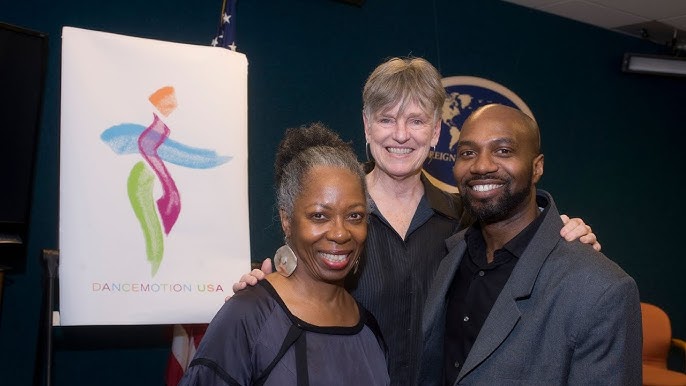
Dance as diplomacy possesses a short though rich history in the United States spanning many continents and varied reasons for its employment. In this brief paper we will contextualize a new program of cultural diplomacy known as DanceMotion USA within the frame of U.S. diplomatic dance programs of the past. By closely analyzing and scrutinizing said program we might hope to bring to light possible intentions calling for its creation and funding while attending to those possible unintended consequences.
A History of Dance Diplomacy
The history of dance diplomacy in the U.S. is a relatively short one, which interestingly enough follows the timeline of the Cold War almost perfectly. Beginning in 1954 the Department of State received funding through the newly authorized President’s Emergency Fund of International Activities. Set up by President Eisenhower for the public purpose of facilitating the overseas touring of American dance, theater, music and sports, the true purpose of the tours was to target communist influence in uncommitted countries within Latin America, Asia and Africa.1
Throughout the proceeding years up until the 1980’s, dance companies enjoyed a long period of government funding for overseas touring. Companies as diverse as Alvin Ailey Dance Theater, Nikolais Dance Theater, New York City Ballet, Martha Graham, Merce Cunningham and American Ballet Theater benefited from the generous budgets of the Department of State’s international dance touring program.2
During the Regan administration in the 1980’s, Department of State funding for dance touring dwindled along with that of the National Endowment for the Arts and other arts related funding.3 By the 1990’s Department of State funding had completely disappeared for dance touring. All that remained was occasional funding for individual choreographers to travel abroad working both to set previously choreographed work and to produce new works on foreign dancers. Fast-forward to 2010 when a culture conscious president sits in the White House and funding has been restored to the NEA as well as many other arts related programs. Funding in the amount of $1.5 million dollars is secured for overseas touring of three renowned American dance companies through a new Department of State program, DanceMotion USA.4 A new era of post Cold War dance diplomacy is born.
Why Dance?
When considering this type of diplomacy the first question which might or should enter the mind is, ‘why dance?‘ Well, because movement, the language of dance, is fundamental to all human existence and does not depend on the spoken or written word, dance is able to overcome many language and cultural barriers which other art forms cannot. Also, because of this fundamental nature dance allows for a deeper understanding and connection than words are able to facilitate. However, even though dance may find it easy to cross these boundaries, cultural differences relating to gesture may cause some movements to be read differently than the intended meaning. We must also be careful here that the abstract nature of dance does not fog the true message being relayed. Many contemporary works are mired in abstraction so much that the content of the work is generally more interpretive than the text based and spoken arts. This can work both positively and negatively in respect to diplomacy. If the intent of the communication is to be clear and direct then some forms of dance may not be ideal considering their abstract nature. Conversely, abstraction may be ideal if the true intent of the communication is duplicitous.
DanceMotion USA
Descending through six layers of bureaucracy, the US Government, the Executive Branch, the Department of State (DOS), the Bureau of Educational and Cultural Affairs (ECA), Citizen Exchanges and the Cultural Programs Division, we finally happen upon DanceMotion USA.5 A recent addition to the Department of State’s tool bag of diplomacy, the program was founded in 2008, though it was officially launched just this year in January of 2010. As stated on the program’s website, DanceMotion USA has as its goal, “to share work by some of America’s finest contemporary dance makers and serve as a gateway for cultural exchange.”6 At first glance this purpose may seen quite straight forward, it hopes to open a cultural dialogue between the U.S. and other nations of the world by sending the work of great American choreographers abroad. However, with $1.5 million in funding and taking into consideration the poor track record of government funding of the arts in the U.S. it seems uncharacteristic for the interests of the United States to be simply investing in sending dance companies abroad in the name of cultural exchange. This we will dissect after we define what exactly DanceMotion USA is and what is does.
The DanceMotion USA pilot program of 2010 facilitated the touring of three very unique American dance companies to sixteen cities spread throughout nine different countries.7 Funded mostly through the Department of State and Produced by the Brooklyn Academy of Music the program was managed in each host country by the U.S. Embassy and/or Consulate residing there. The embassies worked with institutions, venues and artists that are deeply rooted and invested in those communities visited to organize public performances, master classes, lectures, demonstrations, workshops, media outreach and exchanges with in-country artists.8 One-on-one communication through the various activities provided a humanistic approach that went beyond simple presentation of an art form but to an engaging in dialogue that otherwise would not have taken place.9 As claimed by the ECA, “The fiscal year 2008 pilot DanceMotion USA program demonstrated the effectiveness of dance in communicating American ideals and values despite language and other cultural barriers.”10
According to the Department of State, the ideal audience for DanceMotion USA is, “those who do not have regular access to American culture, including younger and underserved populations.”11 This is an interesting distinction, which could result from a number of intentions. The first and second possible intentions, both bringing about change to a country’s political and/or social structure, respectively possess a positive and a negative intent. Regarding the former intent, a sure way for a country to progress from that of a third world to a second or first world is by elevating the status and social standing of its underserved. Traditionally this is achieved through education and/or employment. DanceMotion USA carries with it an educational component meant to both educate participants and enable critical thinking. The former intent, recognizing that the underserved in most third and second world countries make up the majority, seeks to change the character of a country by influencing these majorities to rise up and demand change.
A third intention centers on DanceMotion USA’s desire to reach a younger audience. The idea being that the youth of today are the leaders of tomorrow. Influence their thinking and you effectively change the face of that particular country in a nonviolent way.
Funding and Filtering the Message
In changing our focus to program funding we would do well to ask if the DOS foots the entire bill for this seemingly very expensive program? The short answer is no, though they do cover around 80% of expenses directly related to the program. The other 20% is covered by the producing organization.12 In the case of the pilot program, BAM contributed funds to complement those the Department of State provided. Additionally, the education component of DanceMotion USA is funded by Pfizer with additional funding provided through the Robert Sterling Foundation.13 With this in mind, the program is very much enmeshed in the American model of arts funding relying on private as well as government funds. Perhaps one reason why the DOS contributes so much to a program it outsources to a producer is that by holding the proverbial purse strings it is able to demand control of the entire process from creation to curtain down.
According to the Department of State’s request for grant proposals from potential producers, the ECA is “substantially involved in program activities above and beyond routine monitoring.”14 Responsibilities of the ECA include, determination of tour countries, review and final approval of dance companies, approval of all tour arrangements, arrangement of DOS officer participation and approval of all media and public relations strategies.15
Countries and Companies
Taking a look at the countries chosen as part of the 2010 pilot we can speculate a host of reasons why the U.S. would want to engage those particular countries in a diplomatic dialogue. The first three countries of the program, which were visited by Urban Bush Women, are Brazil, Colombia and Venezuela, all located in South America. According to the CIA World Factbook, the U.S. has strained relations with Brazil relating to them in a cold and distant manner.16 Colombia is fighting an internal “War on Drugs” with the help of he U.S.17 and Venezuela broke diplomatic ties with the U.S. during the Bush Administration in September of 2008 only having recently re-established those ties with the Obama Administration in 2009. Venezuela also ranks 8th in the world for oil exports and 11th in oil production.18 Again these are simply speculative reasons for engagement. Nonetheless, they are perhaps quite valid reasons.
In diverting our attention to the company that toured these three countries, Urban Bush Woman (UBW), we might find reasons for pairing this particular tool of diplomacy with this particular part of the world. On their website UBW describes themselves as,
A performance ensemble founded in 1984 by choreographer Jawole Willa Jo Zollar to explore the use of cultural expression as a catalyst for social change. UBW weaves contemporary dance with music and text to illuminate the history, culture, and spiritual traditions of African Americans and the African Diaspora.19
Another important qualifier about UBW that would help in our analysis is that, as apparent from their website, most of the company is of mixed or African American descent. Given that these three South American countries have a high concentration of peoples of mixed race, particularly Afro-European, we begin to see why UBW might be the ideal company to visit these countries. A further reason for this combination may be found in the company’s purpose above. South Americans are all too familiar with social change, though mostly through political upheaval of dictatorial regimes. With this in mind, they may relate well to the themes of social change and community gathering/organizing inherent in the work of UBW.
The next set of countries, visited by Evidence: A Dance Company, are Nigeria, Senegal and South Africa, all in Africa. Again turning to the CIA World Factbook we find that Nigeria ranks 5th in oil exports, 10th in oil reserves and 15th in oil production.20 After a series of human rights abuses in the 1990’s the U.S. now has excellent relations with Senegal.21 Finally, post apartheid the U.S. has apparently maintained good relations with South Africa.22
Evidence, A Dance Company was founded by choreographer Ronald K. Brown in 1985. The Company’s mission is to promote understanding of the human experience in the African Diaspora through dance and storytelling and to provide sensory connections to history and tradition through music, movement, and spoken word.23
Simply put, with an African American choreographer and a mostly African American cast, creating works in the African Diaspora, it is not altogether difficult to realize why this group would be an ideal company to send to Africa.
The final set of countries, visited by ODC/Dance, are Burma, Indonesia and Thailand, all in Southeast Asia. Burma is currently under the control of a military regime.24 Indonesia’s location provides superb coordinates for regional security; it has also played a pivotal role in helping to spread democracy throughout the region.25 Thailand and the U.S. have maintained excellent relations since the 1833 Treaty of Amity and Commerce.26
Though ODC/Dance’s mission says nothing that would relate them to Southeast Asia, in close analysis of the company’s dancers we quickly see the most obvious possible reason. Headquartered in San Francisco, a city that in 2000 held an Asian population of over 30%,27 half of ODC’s dancers are of Asian descent.28
From the ethnic makeup of each company to the content of that which they perform, these factors seem to be a subtle and clear shot way to gain a sympathetic entrance into the lives of those communities each company enters. These similarities between visitor and visited act to smash down the wall of “the other” and provide a forum for understanding and connecting to America as a culture of people “just like us.” The fact that the U.S. has for the most part calm relations with all of the aforementioned countries may also speak to their being chosen as colleagues fit to engage in cultural exchange.
Intentions vs. Consequences
In the devising and implementation of any program or policy there will always arise unintended consequences whether positive or negative. In regard to DanceMotion USA, sending a select number of dance companies abroad may define American dance within a very narrow scope. Though, perhaps, this is a good thing in that when trying to connect with audiences of a particular ethnicity or sensibility matching these characteristics to the work being presented allows for an even further breaking down of barriers than completely unfamiliar work would. Another consequence to consider is that of presenting a very controlled and limited scope of American culture/ideology/values. It would seem that in most instances of cultural diplomacy a nation would prefer this “managed” persona rather than one truly reflective of diverse national ideologies.
One final possible consequence for a program such as DanceMotion USA could be the superimposition of the foreign country’s culture upon that of the host country’s. By examining the facts presented, DanceMotion USA seems instead to encourage acceptance and even coexistence of both cultures. The fact that the foreign dancers not only gave workshops, but also took them from local artists in the host country exemplifies this. In one instance, the foreign company was even taught a traditional dance from the host country’s classical repertoire that the visiting company then performed in their public performance. 29
Conclusion
Based on the brief and hardly conclusive analysis above the author would like to suggest the impetus behind creating DanceMotion USA springs forth from intentionalist ideology. The specific intent behind the program seems to have a twofold purpose, the promotion of a positive American image abroad, on the humanistic level of the individual and the mutual appreciation of one another’s culture through the dialogue of cultural exchange.
If there are duplicitous reasons for the creation and funding of this program by the U.S. government then it is very hard to isolate them. One would hope that in this day and age of increasing knowledge not only of the self but also of “the other” that the reasons for such a program would be transparent and in the true spirit of cultural exchange. However, with status and positions of power at stake all too often it seems that diplomacy, the art of deceit, is just that. Without a more extensive analysis we may never know.
Notes
1. Croft, Clare. “Diplomats of Dance: U.S. Companies Step into Role as Cultural Representatives Abroad – Part 2.” Dance/USA ejournal, November 4 2010, http://www.danceusa.org/ejournal/post.cfm/diplomats-of-dance-u-s-companies-step-into-role-as-cultural-representatives-abroad (accessed November 28, 2010). 1.
2. Croft, Part 2, 1.
3. Bauerlein, Mark, Ed., National Endowment for the Arts: A History 1965-2008. Washington, DC: National Endowment for the Arts, 2009. 69.
4. Croft, Clare. “Diplomats of Dance: U.S. Companies Step into Role as Cultural Representatives Abroad – Part 1.” Dance/USA ejournal, November 2, 2010, http://www.danceusa.org/ejournal/post.cfm/diplomats-of-dance-u-s companies-step-into-role-as-cultural-representatives-abroad-part-1 (accessed November 28, 2010). 1.
5. DanceMotion USA. “About DanceMotion USA.” The Program. http://www.dancemotionusa.org/about.aspx (accessed November 27, 2010).
6. DanceMotion USA, The Program.
7. DanceMotion USA BlogSpot. “DanceMotion USA.” DanceMotion 2010, a recap. http://dmusa.blogspot.com/ (accessed November 28, 2010).
8. DanceMotion USA, The Program.
9. Croft, Part 1, 1.
10. U.S. Department of State. DanceMotion USA: Request for Grant Proposals. Washington, DC: Office of the Federal Register, 2010.
11. U.S. Department of State, Grant Proposals, 1.
12. U.S. Department of State, Grant Proposals, 5.
13. DanceMotion USA, The Program.
14. U.S. Department of State, Grant Proposals, 4.
15. U.S. Department of State, Grant Proposals, 4.
16. Central Intelligence Agency. “CIA World Factbook” South America: Brazil. https://www.cia.gov/library/publications/the-world-factbook/geos/br.html (accessed December 2, 2010).
17. Central Intelligence Agency. “CIA World Factbook” South America: Colombia.https://www.cia.gov/library/publications/the-world-factbook/geos/co.html (accessed December 2, 2010).
18. Central Intelligence Agency. “CIA World Factbook” South America: Venezuela. https://www.cia.gov/library/publications/the-world-factbook/geos/ve.html (accessed December 2, 2010).
19. Urban Bush Women. “About Urban Bush Women.” Mission and Core Values. http://www.urbanbushwomen.org/mission_values.php (accessed November 28, 2010).
20. Central Intelligence Agency. “CIA World Factbook” Africa: Nigeria. https://www.cia.gov/library/publications/the-world-factbook/geos/ni.html (accessed December 2, 2010).
21. Central Intelligence Agency. “CIA World Factbook” Africa: Senegal. https://www.cia.gov/library/publications/the-world-factbook/geos/sg.html (accessed December 2, 2010).
22. Central Intelligence Agency. “CIA World Factbook” Africa: South Africa. https://www.cia.gov/library/publications/the-world-factbook/geos/sf.html (accessed December 2, 2010).
23. Evidence: A Dance Company. “Mission & History.” Mission Statement. http://evidencedance.com/index.php?option=com_content&view=article&id=50&Itemid=66 (accessed November 28, 2010).
24. Central Intelligence Agency. “CIA World Factbook” South & Southeast Asia: Indonesia. https://www.cia.gov/library/publications/the-world-factbook/geos/id.html (accessed December 2, 2010).
25. Central Intelligence Agency. “CIA World Factbook” South & Southeast Asia: Burma. https://www.cia.gov/library/publications/the-world-factbook/geos/bm.html (accessed December 2, 2010).
26. Central Intelligence Agency. “CIA World Factbook” South & Southeast Asia: Thailand. https://www.cia.gov/library/publications/the-world-factbook/geos/th.html (accessed December 2, 2010).
27. Sanfranguide. “Factoids.” San Francisco Population. http://sanfranguide.com/factoids/population/ (accessed November 30, 2010).
28. ODC Dance Company. “Artistic Directors & Dancers.” Dancers. http://www.odcdance.org/dance_innerpage.php?linkid=10&categid=27&subcategid=35 (accessed November 28, 2010).
29. Croft, Part 1, 1.
Bibliography
Bauerlein, Mark, Ed., National Endowment for the Arts: A History 1965-2008. Washington, DC: National Endowment for the Arts, 2009.
Central Intelligence Agency. “CIA World Factbook” South & Southeast Asia: Indonesia. https://www.cia.gov/library/publications/the-world-factbook/geos/id.html (accessed December 2, 2010).
Central Intelligence Agency. “CIA World Factbook” South & Southeast Asia: Burma. https://www.cia.gov/library/publications/the-world-factbook/geos/bm.html (accessed December 2, 2010).
Central Intelligence Agency. “CIA World Factbook” South & Southeast Asia: Thailand. https://www.cia.gov/library/publications/the-world-factbook/geos/th.html (accessed December 2, 2010).
Central Intelligence Agency. “CIA World Factbook” South America: Brazil. https://www.cia.gov/library/publications/the-world-factbook/geos/br.html (accessed December 2, 2010).
Central Intelligence Agency. “CIA World Factbook” South America: Colombia. https://www.cia.gov/library/publications/the-world-factbook/geos/co.html (accessed December 2, 2010).
Central Intelligence Agency. “CIA World Factbook” South America: Venezuela. https://www.cia.gov/library/publications/the-world-factbook/geos/ve.html (accessed December 2, 2010).
Central Intelligence Agency. “CIA World Factbook” Africa: Nigeria. https://www.cia.gov/library/publications/the-world-factbook/geos/ni.html (accessed December 2, 2010).
Central Intelligence Agency. “CIA World Factbook” Africa: Senegal. https://www.cia.gov/library/publications/the-world-factbook/geos/sg.html (accessed December 2, 2010).
Central Intelligence Agency. “CIA World Factbook” Africa: South Africa. https://www.cia.gov/library/publications/the-world-factbook/geos/sf.html (accessed December 2, 2010).
Croft, Clare. “Diplomats of Dance: U.S. Companies Step into Role as Cultural
Representatives Abroad – Part 1.” Dance/USA ejournal, November 2, 2010, http://www.danceusa.org/ejournal/post.cfm/diplomats-of-dance-u-s companies-step-into-role-as-cultural-representatives-abroad-part-1 (accessed November 28, 2010).
Croft, Clare. “Diplomats of Dance: U.S. Companies Step into Role as Cultural Representatives Abroad – Part 2.” Dance/USA ejournal, November 4 2010, http://www.danceusa.org/ejournal/post.cfm/diplomats-of-dance-u-s-companies-step-into-role-as-cultural-representatives-abroad (accessed November 28, 2010).
DanceMotion USA. “About DanceMotion USA.” The Program. http://www.dancemotionusa.org/about.aspx (accessed November 27, 2010).
DanceMotion USA BlogSpot. “DanceMotion USA.” DanceMotion 2010, a recap. http://dmusa.blogspot.com/ (accessed November 28, 2010).
Evidence: A Dance Company. “Mission & History.” Mission Statement. http://evidencedance.com/index.php?option=com_content&view=article&id=50&Itemid=66 (accessed November 28, 2010).
ODC Dance Company. “Artistic Directors & Dancers.” Dancers. http://www.odcdance.org/dance_innerpage.php?linkid=10&categid=27&subcategid=35 (accessed November 28, 2010).
Sanfranguide. “Factoids.” San Francisco Population. http://sanfranguide.com/factoids/population/ (accessed November 30, 2010).
Urban Bush Women. “About Urban Bush Women.” Mission and Core Values. http://www.urbanbushwomen.org/mission_values.php (accessed November 28, 2010).
U.S. Department of State. DanceMotion USA: Request for Grant Proposals. Washington, DC: Office of the Federal Register, 2010.
© 2010 Curtis Stedge
