
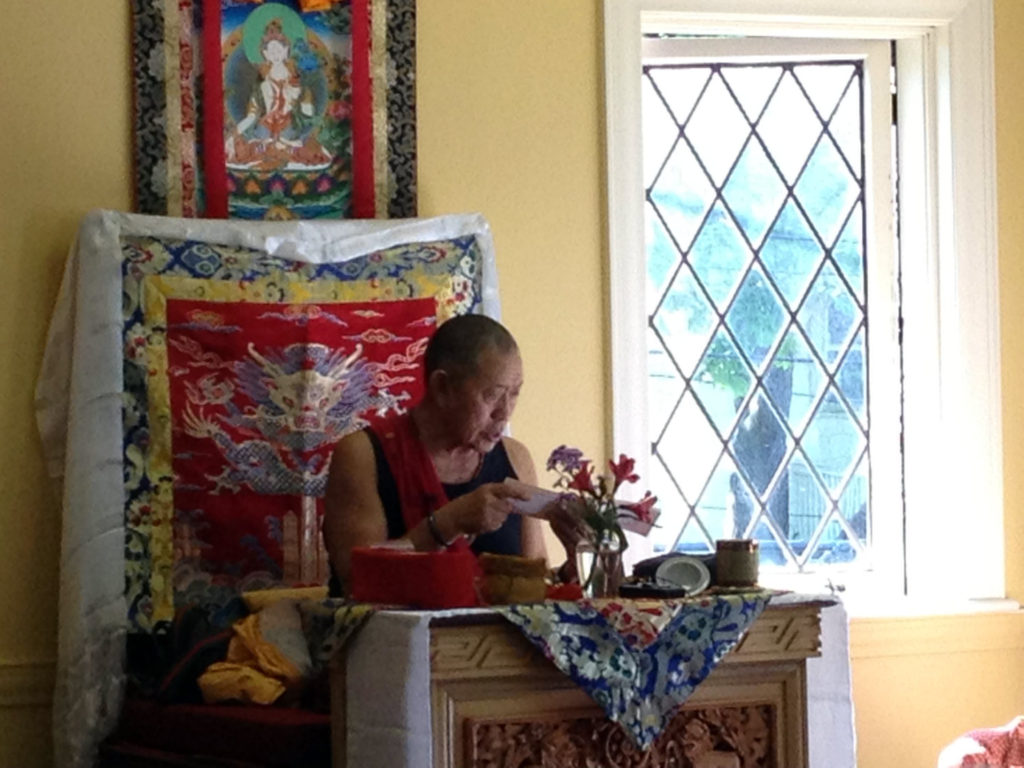
Jewel in the Lotus
The White Lotus Society in Rochester, NY, is a Tibetan Buddhist Dharma Center in the Drikung Kagyu lineage, of which I am a member. The center is devoted to diffusing the Teachings of the Buddha throughout the United States and to preserving Tibet’s rich and unique cultural heritage. As in all Tibetan Buddhist temples, at the very heart of practice within this Dharma Center, there lie the Three Jewels of Buddhism. They are Buddha, the teacher, also referred to as the mind’s perfection of enlightenment; Dharma, the word of the Buddha, also conceptualized as phenomenon; and Sangha, the community of practitioners in support of one another. These Three Jewels operate together and cannot of themselves lead a practitioner to enlightenment. An intimate understanding of all three must be cultivated. In this brief paper we will highlight one form of religious or bucolic art from each of these elements of practice in order to develop a better understanding of how this particular society is organized and influenced through its various beliefs and artistic practices.
Buddha
Various manifestations of the Buddha can be found in many forms, sizes and styles within The White Lotus Society. The most prevalent of these manifestations is in the form of brightly colored images called thangkas. There are two main elements to a thangka: a cotton panel, which is painted or embroidered; and a brocade textile upon which the panel is mounted. Wooden dowels at the top and bottom of the thangka allow for it to be easily rolled like a scroll for storage. For this reason they are often referred to as scroll-paintings.
Painted by highly skilled masters, thangkas visually represent the many deities, sacred beings and saints that are manifestations of the original Buddha and ultimately the self. They are didactic in nature, and communicate iconographic ideas to the practitioner that are thought to accelerate a comprehensive understanding of the subject matter. Symbolic meaning can be found in the clothing and jewelry that adorn the deity as well as in those objects and phenomenon that surround them. Thangkas encourage a somewhat direct transmission of a desired mind-state by allowing practitioners to manifest the qualities of a deity through mental embodiment of that particular deity. This physical representation of an intangible concept is a tool for recognition of what we call Tantra. That is everything that we need to be complete is within us at this very moment. We merely need to recognize it. Hence the belief that those beings illustrated are reflections of our own inner being that we have yet to realize.
To an outsider, these images of wrathful and compassionate beings may seem quite intimidating and fearsome. However, the practiced insider knows that they are rather complex projections of the self and that even the most horrific looking deity is actually a protector. This duality of opposing energies was devised to highlight for the practitioner the contemporary polarities rooted in the human mind.
Discouraging, as it may seem to the new initiate, there is no introductory course to thangkas and the many types of beings they represent. If a practitioner does not engage in this type of research of their own accord, which they should, then learning will progress only as often as one attends temple. They may find comfort though in knowing that even the most practiced of The White Lotus Society members, after thirty years, still finds new layers of meaning within the thangkas that decorate the walls of the altar room.
Dharma
Dharma scripture at The White Lotus Society is recorded in the traditional Tibetan style, on long and narrow loose-leaf pages, in this case 4 inches by 11 inches. The covers of these books are often times ornately carved from or intricately painted on wood. Images of the Yidam, or meditational deity, which a particular text belongs to, as well as various auspicious symbols, adorn the cover. Texts are written in Tibetan with an English translation provided directly below the Tibetan script.
There are essentially three stages to a prayer text: taking refuge in the Three Jewels of Buddha, Dharma and Sangha; the body of the text which includes the visualization of the deity and recitation of the mantra, that is an instrument of thought or protection of the mind; and the dissolution stage. As Buddhists we understand that the only place one can ultimately take refuge is within oneself. Recognizing the Buddhist belief that we are all, at our core, the same universal energy, taking refuge in the Three Jewels can then be understood fundamentally as taking refuge within ourselves. During the visualization and mantra stage, the practitioner generates a mental picture of the deity aided not only by the written text but simultaneously with the visual image of the thangka as well. This complex, detailed picture facilitates a dynamic, comprehensive, mental visualization of the distinct deity, to who the concerned text belongs. Through the dissolution stage we acknowledge the impermanence of existence by dissolving our visualization into nothingness and resting in the Mahamudra state, absolute reality, of clear mind. The prayer is then closed with a dedication of the merit generated to the benefit of all sentient beings.
Though even the most fearsome of deities are considered protectors as mentioned above, it is believed that the inherent power of these deities can only be wielded and understood by those who are fully trained and prepared through proper instruction and various protections. For this reason, before a practitioner commences use of a particular text they must first receive the transmission of that text by a qualified Lama. This ritualized transmission called Empowerment, Wang in Tibetan, represents the passing of spiritual esoteric knowledge from teacher to student and initiates the student into a particular tantric deity practice.
In completing an empowerment the student enters into a samaya vow with the Lama who is passing down the teaching. The terms of this agreement are decided upon between teacher and student and may vary depending on the spiritual needs of the student.
The empowerment ceremony is full of Tibetan style pomp and circumstance with much chanting, prayer, ritual music and performance. The defining moment of the transmission occurs in two parts: first when the Lama blesses the student with an image of the deity and ultimately when the student sincerely believes in his or her heart that they have fully received the teaching. This intimate process establishes for the student, a deep connection to and reverence for the teacher. Furthermore the ceremony forms a strong root system upon which the student’s spiritual practice may grow and flourish.
Sangha
Every Sunday between the Dharma talk, the Buddhist equivalent to the Christian sermon, and prayer, the Sangha or community of fellow practitioners enjoy a fifteen-minute tea break. In a small room adjoining the center’s kitchen a volunteer sets out coffee mugs, brews a fresh pot of coffee and makes certain to heat a kettle full of fresh water for tea. Most practitioners choose their respective brand and flavor of tea while others choose to partake of the coffee. Usually one or two practitioners will bring various snacks to share and be had during the tea break. Over the fifteen-minute break practitioners may converse with old friends, peruse the center’s gift shop or many times have the opportunity to introduce themselves to first time attendees.
The use of tea within Buddhist temples has an ancient and gruesome origin dating back to a legend surrounding Bodhidharma, the monk who first brought Buddhism to China. After meditating for nine long years without rest, Bodhidharma eventually grew very weary and fell asleep. He was so angered by this and disappointed with his wavering self-discipline that he cut off his eyelids and threw them to the ground. They immediately took root and became the first tea bush.1 Ever since, monks have used tea as a means to remain awake during long sessions of meditation. The low dose of caffeine is just enough to keep one awake but not enough to over stimulate the body and mind.
If we look to the West for tea’s purposeful existence we need look no further than the local coffee house or tearoom. Here, tea along with its more popular Western counterpart coffee, have become synonymous with socialization and the exchange of ideas.
Upon careful inspection, tea breaks at The White Lotus Society meld Eastern and Western ideologies for the use of tea into a bucolic ritual. Tea here serves both as a social lubricant strengthening the bonds of this particular Sangha and as a stimulant to keep the minds of individuals within this same group awake and alert before they commence with meditation.
Not surprisingly this ritual performed by the Sangha not only strengthens the connection between its individual members, but also facilitates a more effective practice, which leads to a better understanding of the scriptures and ultimately the Dharma.
All Are One
As has been hinted upon throughout this paper, The Three Jewels of Buddhism acting simultaneously have a cyclical nature of cause and effect about them. Sangha facilitates a deeper understanding of and connection to the Dharma through practice, contemplation and, as in our example of the tea break, a mutual interchange of ideas. The Dharma in turn enables us to achieve Buddha mind, or enlightened thought, through prayer and meditation, aided by our 4 inch by 11 inches texts. Finally, the Buddha as the first human being to achieve Nirvana provides an example of enlightened mind and acts as a guide to the Sangha and its individual members, as represented in our many thangkas. Ultimately, the Buddha is evidence that Nirvana is attainable for the Sangha through the Dharma. Another way of envisioning this triad is to see Buddha nature as the ultimate goal, Dharma as the means or vehicle by which to reach the goal and Sangha as the support system along the way.
This interconnectedness, observable in religious practice and art, is mirrored throughout this particular society and the larger Buddhist community, which it is a part of. If one part of the Three Jewel triad were to be removed the result would be an unraveling of the very fabric that organizes the society. Art and Religion are inextricably linked within The White Lotus Society, so much that all art is religious or bucolic in nature and serves a religious purpose. Historically this agrees with the origin of the Drikung Kagyu lineage in Tibet, where the Tibetan head of state, the Dalai Lama, is also the spiritual leader of the country.2 For us in the West, there is a definite separation of church and state. However, as evident above, religious art and practice at The White Lotus Society meets practitioners at such a basic and elemental level that it permeates the individual’s existence. This recognition that art is essential to life and society within this particular group could ultimately and should be used to inform further investigation as to how societies and governments can better organize themselves through their native or borrowed art.
Notes
1. “Bodhidharma.” Britannica Biographies (January 2008): 1. MasterFILE Premier, EBSCOhost (accessed October 1, 2009).
2. Willis, Michael. Tibet: Life, Myth and Art. (London: Thorsons. 2003). 116.
Bibliography
“Bodhidharma.” Britannica Biographies (January 2008): 1. MasterFILE Premier, EBSCOhost (accessed October 1, 2009).
Willis, Michael. Tibet: Life, Myth and Art. London: Thorsons. 2003.
© 2009 Curtis Stedge
