
Dance is a universal language that traverses cultural, political and social boundaries. With this in mind it has the potential to be a powerful unifying factor or a dangerous tool of conquest. For this reason it is necessary that we understand how dance has been and could be abused to further the perverse ideology of oppressive States.
To that end, this paper will explore the cultural, political, and social contexts of the use of dance in and around the 1936 Berlin Olympics and the 2008 Beijing Olympics. By no means a definitive account of these issues the hope is to shed light onto the similarities and differences of each State’s intended purpose for engaging dance as a tool of the State.
Dance and Cultural Policy in Nazi Germany
Unlike its position in many other countries even today, dance found a reputable place within the Third Reich. After much deliberation in defining this position of favor, due to its obsessive need to structurally organize not only all art forms but all facets of culture as well, the Ministry of Propaganda organized dance under an independent Fachshaft that was to be housed within the Reich Theater Chamber. Though this boded well for German Dance, as Karina and Kant suggest, “Administrative integration of dance as an art form into the total Nazi State required more than a unified structure; it involved a complex and tedious process of definition of the many facets of dance as a professional and amateur activity.”1 What resulted was a highly bureaucratic structure that would ultimately stymie the unprecedented growth the German Dance had experienced up until about 1936.
The Nazi “takeover” of dance happened rather quickly and without much outcry from the dance field. In fact by 1933 the field had already adopted measures to unite under Nazi ideology and operate in subordination to the will of the State. Fortunately for dance, Otto von Keudell, the civil servant responsible for much of the execution of the process that Karina and Kant describe above, turned to the expertise of Rudolf von Laban to mastermind the process.2 Now considered to be the most important and influential contributor to dance in the twentieth century, Laban’s ideas on dance, especially its unifying factor greatly appealed to Nazi sensitivities. Though Laban himself was not entirely won over by the Nazi regime he had aspirations of his own he wished to pursue through his newfound position.
Laban envisioned large choric dances, masses of people moving in unison, acting as one entity while reaching towards the ideals of harmony with nature and a unified utopian society. Not surprisingly, this is exactly the vision he attempted to bring to fruition when in 1936 he was to organize a great dance festival and the opening ceremony for the Olympics in Berlin. By this time the list of Laban’s accomplishments had grown extensively since he was first given control over the organization and management of the dance profession. His most impressive achievements were the creation and execution of the German Dance Master Workshops and the institution of national standards for dance in Germany.3 The most wide sweeping effect that these priorities had on the German Dance was that anyone wishing to become a professional working dancer had to attend one of Laban’s national institutions, the Master Workshops. This gave him unquestionable control over the identity of German Dance.
Unfortunately for Laban his grandiose vision crashed down around him much quicker than its realization. For the opening ceremony of the 1936 Olympics Laban had choreographed a new work he had titled, Of the Warm Wind and the New Joy. The dress rehearsal was attended by Joseph Goebbels, Director of the Ministry of Propaganda. A June 21, 1936 entry in Goebbels diary reads, “… Dietrich Eckhart Theater. Rehearsal of dance piece – free adaptation of Nietzsche, badly done and artificial work. I prevent a lot. That is all too intellectual. Goes around in our costume but is not really one of our own.”4
Following this dress rehearsal, Goebbels reprimanded Laban for creating such “intellectual” work and banned the piece from public performance.5 There still to this day exists controversy as to whether Laban’s work was too intellectual or whether it was felt that the man himself was deemed too powerful in organizing and “moving” great masses of people in unison. Either way Goebbels must have been concerned for the security of the State.
Around this same time and just before the opening of the 1936 Olympics, Otto von Keudell was dismissed from the Ministry. With Keudell’s dismissal went all favor and sanctuary for Laban and his now degenerate ideology. This was all too apparent when Rolf Cunz was installed to replace Keudell. A Nazi from the beginning of the party’s creation Cunz was a cruel and arrogant man belonging to the “well-to-do-bourgeoisie.”6 He had no tolerance for the frivolity of high culture. This combination of traits made him an especially potent enemy of Laban and the German Dance.
The 1936 Olympics
Awarded to the Weimar Republic on April 24, 1931, two years before the Nazi’s came to power, the Olympic games were a sign that the world, or at least the International Olympic Committee (IOC), was ready to accept Germany as a changed and civil nation. Following German aggression during the First World War the country was banned from Olympic participation until the 1932 Los Angeles Games.7
Since the awarding of the sixth Olympic games to Germany, which never came to fruition because of the impending war, Dr. Theodor Lewald and Carl Diem of the German Organizing Committee (GOC) had been planning the execution of a German hosted Olympics. When the eleventh Games were awarded to Germany, Lewald and Diem again presided over their planning.8 Interestingly, Hitler initially found no interest in the Olympics. To the contrary he believe them to be antithetical to his own beliefs regarding racial superiority. Eventually with the help of Lewald, whose intentions were purely to save the Games from being cancelled, and Goebbels, whose intentions were much more calculated and sinister, Hitler began to take a keen interest in their planning. This newfound interest was of great personal strife to Lewald, the president of the GOC, so much that, “…he signed a secret Interior Ministry document stating that while the GOC retained the authority to deal directly with the IOC, Germany’s Olympic organizers must defer to Reich officials “in all essential matters of policy.” The GOC’s “independence” therefore, was purely for show.”9
From this point forward the Ministry of Propaganda was given full authority for the planning and execution of the Games.
Dance in the 1936 Olympics
In the end, dance’s role in the Opening ceremony played a much smaller role than was originally intended. A great festival dance was performed, Olympic Youth, however, it was a strange amalgamation of dance and athleticism based on the growing obsession for the new Nazi body culture.10 Olympic Youth contained many elements that pointed to German policy on racial intolerance and Aryan superiority. All participants were tall and slender with blonde hair and blue eyes, reflecting Hitler’s vision of the new German super race.
The only true art dance performances occurred during the evening when the works of the great German choreographers Mary Wigman, Greta Palucca and Harold Kreutzburg were performed.
By the end of the Olympic games foreigners left Germany with a much different idea of the State than the dark images most had arrived with. This is most assuredly due to the Nazi orchestration of the Games in that “…the emphasis on peace and understanding between nations made it hard not to have doubts that perhaps the New Germany had been misunderstood.”11
Given the fact that Hitler at first rejected the Olympic Games and later embraced them we might assume that the Reich’s policy regarding said games fluctuated from a functionalist to an intentionalist perspective. By the start of the Games in 1936 there was most definitely a Nazi agenda to use the Olympics as propaganda, clouding the view of the true Nazi State. For dance, a different argument could be made. It seems that with how much the management of dance changed from Kueller embracing the German modern dance to Cunz dismantling the “intellectual” German modern dance the policy towards dance appears to be functionalist.
Dance and Cultural Policy in Communist Chinese
By the time Deng Xiaoping rose to power in 1978 the arts were greatly demoralized by Mao’s Cultural Revolution. Management of the arts sector during Mao’s reign was placed in the hands of the State. The State owned everything. Individualism gave way to a unified nation with a unified voice, the voice of Communism. During his reign of terror on all things cultural Mao believed modernization was only possible only by getting rid of the old and replacing it with brand new, monitored culture. Conversely, the arts under Xiaoping enjoyed declining political supervision, a growing cultural marketplace, greater autonomy and increased access to outside culture.12
By the end of China’s Cultural Revolution the state of dance within the communist state was extremely sobering. This can best be explained by the sorrow that Liang Lun, a dancer who by 1979 had been practicing Chinese dance for forty years, feels in this regard as expressed in the following excerpt from Paul Clark’s book, The Chinese Cultural Revolution: A History. “Many young dancers by the late 1970’s had a narrow, formalistic approach to their art: Dances that did not feature big leaps and spins seemed bland to his students. They were not particularly interested in works that drew on the Chinese national or ethnic roots. The inflated rhetoric of the Cultural Revolution included large, empty gestures on the dance stage. Real meaning and authentic emotion were hard to find. For Liang, the bombastic and ultimately barren notions of art in those years still lingered and had distorted the views of another generation.”13
This aesthetic in some ways seems to still pervade Chinese dance even today. However, after the rise of Deng Xiaoping who opened the country up for capitalist market structures and investment, artists were given some latitude to create work that both the market called for and which was less “structured” by the state.
“The powerful system of control that once bound almost everyone to orthodoxy is now passing. For as 1991 began, not only had belief in the old Chinese Marxist worldview collapsed and been replaced by a new fascination with individualism, democracy and capitalism, but also the submissiveness to authority that was the hallmark of intellectual life had begun to evanesce and to be replaced by a more defiant and unrepentant opposition.”14
Wang below best explains the modernist view on Chinese culture:
“A traditional culture…represents the spirit of the nation and is the source for the re-creation of any newer and higher civilization. Hence, modernization cannot abandon traditional culture, for it is rather a development on the ground of traditional culture. People can modernize their country only by carrying on their own nation’s cultural tradition, not by sheer fabrication.”15
By 1997, the year of Deng’s death, Party ideology had deteriorated so much that it contained little Marxist content.16
The 2008 Olympics
Headquartered in Beijing Olympic Tower within the city of Beijing, the Beijing Organizing Committee for the Games of the XXIX Olympiad (BOCOG) was founded on December 13, 2001, five months after the city was selected to host the 2008 Olympic games. Initially 26 departments were established within the BOCOG to manage the various . By 2008 the BOCOG had expanded to more than 30 departments with a combined staff of around 4,000.17
The organizing committee is managed by an 18 member Executive Committee, the president of which is Liu Qi. Of note and perhaps not surprisingly, the entire 18 member board belongs to the Communist Party of China (CPC), many of which have and do hold high level positions within the party in Beijing.18
“BOCOG’s general goal is to host high-level Olympic games and high-level Olympics with distinguishing features, to realize the strategic concepts of “New Beijing, Great Olympics” and to leave a unique legacy for China and world sports.”19
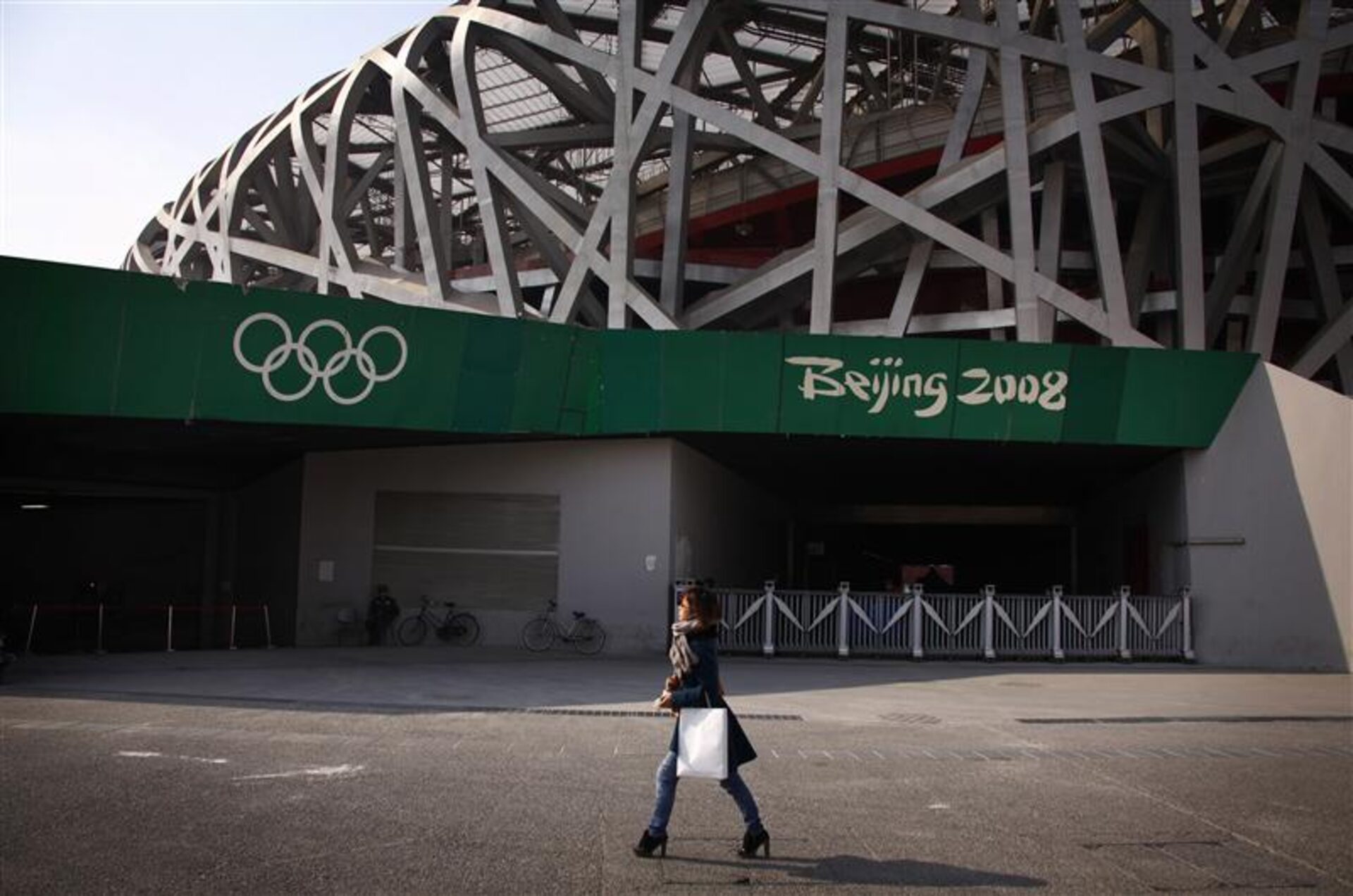
Beijing spared no expense on the 2008 games spending an estimated $400,000,000 on the Bird’s Nest Stadium20 alone and over $32,000,000 on the entirety of the games. The opening ceremony cost a low estimate of $100,000,000. This was twice the cost of the 2004 Athens Opening Ceremony.21
The opening and closing ceremonies, which we are most interested in, were organized by a subset of the BOCOG, The Opening and Closing Ceremonies Operation Center. Founded on January 15, 2007 the OCCOC is promoted as an independent unit that was approved by BOCOG. Its primary purpose is to organize and implement both the opening and closing ceremonies of the 2008 Beijing Olympic and Paralympic Games.22
Dance in the 2008 Olympics
The role of dance in the 2008 Beijing Olympics was limited to the opening and closing ceremonies. The Director of the ceremonies was world famous Chinese film director Zhang Yimou. Zhang’s goal for the performances was to condense 5,000 years of Chinese history into a 50-minute show.23
To aid him in the production Zhang hired world famous Chinese choreographer, now living in New York, Shen Wei. Shen in an interview preceding the games commented to one news source that the details of the ceremony were kept so secretive that he was required to sign a confidentiality contract saying that he would not divulge any information about the performance including content and the number of performers.24
In regards to these performers Shen has said, “These are very good dancers, amazing, wonderful dancers, but everything I do is new to them. They have no modern dance style and I have to train them and teach them from the beginning and throughout.”25
During the same interview hints as to Shen Wei’s personal aesthetic and belief in the purpose of the arts were illuminated when the interviewer asked him, “You said earlier that the arts are the engineer of the soul and money is garbage. Maybe money has ruined the soul of your country?”26
Striving to produce choreography that melded his Chinese heritage with his newfound world culture Shen blended styles of Chinese, modern dance and ballet.
“In New York I live and communicate with people where there is an international culture of art,” Mr. Shen said. “But here I first have to talk to people about the global culture of art where there is also a modern way to do things, not only the Chinese traditional way. I want to show China today, the modern China. We don’t only want to see dragons and lanterns, but want to meld modern culture with Chinese tradition.”27
The choice to employ a world class, world famous film director and a world class, world famous choreographer was obviously a calculated move. Every country producing the Olympic games wishes to put their best foot forward, to display the best of their respective cultures, the most impressive aspects. To that end, the choice of Zhang and Shen logically fits.
The ceremonies were everything you would expect from a Chinese blockbuster film. Visually stunning, elaborate costumes and high-flying acrobatics. The choreography employed held undertones of Communist ideology in the great masses of dancers and drummers moving and speaking in unison. However, it also promoted individualist thought when the solo dancer appeared for the Silk Road dance and other various solos that took place both dancers and singers.
An interesting portrait of the games takes shape when the words of Ai Wei Wei, architect of the Bird’s Nest Stadium, are considered. “How is this Olympics related to the real state of the country, the city and the people? If it is something far away from reality…if many of the historical events are not clarified then it is fake and hypocritical.” Ai Wei Wei is angered that the migrant workers hired to build the stadium he designed were paid a pittance of $150 a month in addition to being marginalized with very few rights. Because of this Ai denounced the building and its construction.28
Though it may be easy to agree with Ai in that the ceremonies do not show the true face of China it is also certain that as stated above, would not every country behave similarly, wanting to show only the best of their culture? For this we cannot fault China, it is merely playing alongside similar offenders. However, with clear and evident abuses of human rights throughout China, especially in Tibet, the Chinese would want to do everything in their power to calm agitated Western minds. An event such as the opening and closing ceremonies offer the perfect opportunity for this. Furthermore, it then seems that perhaps these events hold a dual purpose. On the one hand, such an event to this scale glosses over the barbaric actions of the State, and on the other it glorifies China as a great power with 5,000 years of history and speaks to its readiness to regain its once lost place of political and economic power.
With their call for One World, One Dream and yet these daily abuses it seems China confirms that it is sending a duplicitous message. “Join us in the ceremonious air of peace and justice while we run China as we see fit regardless of right or wrong.” Perhaps this is too strong a charge. It does seem that since Xiaoping’s opening of China to capitalism and in turn democratic ideology, the country has made large steps in transforming itself to a more “free” country. Granted a change from a totalitarian to an authoritarian state is not the best possible one. However, it is apparent that change for the better has been enacted in China. In addition, even though dance may have been used in the ceremonies to promote a glossy, candy covered version of the country, nevertheless, the further opening of China to Western eyes and minds can only help to further illuminate
Remember too that as Laban found prior to the perverse abuse by the State’s will, dance can serve to unite us in harmonious fellowship. It is perhaps this that is most important to remember. Dance within the ceremonies certainly seemed to bring us together as a world people enjoying the same idealized event.
Conclusion
In placing the Berlin and Beijing Games side by side it is clear that the circumstances surrounding the games are markedly different and yet eerily similar. Both countries found their economic power to be rising as well as their position among the great nations of the world. Both were dealing with international outcries of human rights abuses to which they responded with elaborate cover-ups. However, it seems evident that whereas Germany was headed further down the slope of a totalitarian state, China is headed further from it.
Guy Sorman said it best in his book, Empire of Lies, “Will they prove to be another Berlin, or will they revive the spirit of Seoul?”29 Referring to the 1988 Olympics which opened South Korea to democracy and free speech and of course the 1936 Olympics which were twisted by the warped will of the German State. For the hope of the world let us pray that China finds its soul instead of selling it to the cheapest bidder.
Notes
1-2. Karina, Lilian, and Marion Kant. Hitler’s Dancers : German Modern Dance and the Third Reich. New York: Berghahn Books, 2003. pp. 86-87
3. Karina, Lilian, and Marion Kant. Hitler’s Dancers : German Modern Dance and the Third Reich. New York: Berghahn Books, 2003. pp. 113-114
4-5, 10. Karina, Lilian, and Marion Kant. Hitler’s Dancers : German Modern Dance and the Third Reich. New York: Berghahn Books, 2003. pp. 119
6. Karina, Lilian, and Marion Kant. Hitler’s Dancers : German Modern Dance and the Third Reich. New York: Berghahn Books, 2003. pp. 122
7-8. Hart-Davis, Duff. Hitler’s Games : The 1936 Olympics. New York: Harper & Row, 1986. pp. 43.
9. Large, David Clay. Nazi Games : The Olympics of 1936. New York: W.W.
Norton, 2007. pp. 323.
11. Graham, Cooper C. “Leni Riefenstahl and Olympia.” Metuchen, N.J., 1986.
pp. 97
12. Lin, B., and J.T. Myers. Forces for Change in Contemporary China: University of South Carolina Press, 1993. pp. 88.
13. Clark, Paul. The Chinese Cultural Revolution : A History. Cambridge; New York: Cambridge University Press, 2008. pp. 157.
14. Orville Schell, “Kafka, Kundera, Havel and Mao: The Silence of Intellectuals in China,” China Update, Spring 1991, 9. pp. 46.
15. Wang, M., X. Yu, and G.F. McLean. Chinese Cultural Traditions and Modernization: Council for Research in Values & Philosophy, 1997. pp. 44
16. Kraus, Richard Curt. The Party and the Arty in China : The New Politics of Culture. Lanham, Md.: Rowman & Littlefield Publishers, 2004. pp. 227.
17-22. Official site of the 2008 Beijing Olympics, http://en.beijing2008.cn/bocog/about/index.shtml (Accessed February 18, 2011)
20. Al Jazeera English, http://www.youtube.com/watch?v=R-CdWcszb_8
21. NPR, China Celebrates the Opening of the Summer Olympics. http://www.npr.org/ templates/story/story.php?storyId=93420251(Accessed February 20, 2011)
23-27. The Sun, Shen Wei’s Olympic Moves. http://www.nysun.com/arts/shen-weis- olympic-moves/79535/ (Accessed February 20, 2011)
26. American Public Media, The Story. Olympic Choreography.
http://thestory.org/archive/the_story_577_Olympic_Choreography.mp3
(Accessed February, 22, 2011)
28. Al Jazeera English, http://www.youtube.com/watch?v=R-CdWcszb_8
29. Sorman, Guy. The Empire of Lies : The Truth About China in the Twenty-First Century. New York: Encounter Books, 2008. pp. 16.
Bibliography
Al Jazeera English, http://www.youtube.com/watch?v=R-CdWcszb_8 (Accessed February 19, 2011)
American Public Media, The Story. Olympic Choreography. http://thestory.org/archive/the_story_577_Olympic_Choreography.mp3 (Accessed February, 22, 2011)
Clark, Paul. The Chinese Cultural Revolution : A History. Cambridge; New York: Cambridge University Press, 2008.
Graham, Cooper C. “Leni Riefenstahl and Olympia.” Metuchen, N.J., 1986.
Haar, I., and M. Fahlbusch. German Scholars and Ethnic Cleansing, 1919-1945: Berghahn Books, 2005.
Hart-Davis, Duff. Hitler’s Games : The 1936 Olympics. New York: Harper & Row, 1986.
Karina, Lilian, and Marion Kant. Hitler’s Dancers : German Modern Dance and the Third Reich. New York: Berghahn Books, 2003.
Kraus, Richard Curt. The Party and the Arty in China : The New Politics of Culture. Lanham, Md.: Rowman & Littlefield Publishers, 2004.
Large, David Clay. Nazi Games : The Olympics of 1936. New York: W.W. Norton, 2007.
Lin, B., and J.T. Myers. Forces for Change in Contemporary China: University of South Carolina Press, 1993.
NPR, China Celebrates the Opening of the Summer Olympics.http://www.npr.org/ templates/story/story.php?storyId=93420251(Accessed February 20, 2011)
Official site of the 2008 Beijing Olympics, http://en.beijing2008.cn/bocog/about/index.shtml (Accessed February 18, 2011)
Orville Schell, “Kafka, Kundera, Havel and Mao: The Silence of Intellectuals in China,” China Update, Spring 1991, 9.
Sorman, Guy. The Empire of Lies : The Truth About China in the Twenty-First Century. New York: Encounter Books, 2008.
The Sun, Shen Wei’s Olympic Moves. http://www.nysun.com/arts/shen-weis-olympic-moves/79535/ (Accessed February 20, 2011)
Wang, M., X. Yu, and G.F. McLean. Chinese Cultural Traditions and Modernization: Council for Research in Values & Philosophy, 1997.
© 2011 Curtis Stedge
